Tuesday, July 27, 2010

Grevillea and Hakea Pollination

From Pollination
Sources: ANPSA
Wrigley, John W. & Fagg, Murray. (1989). Banksias, Waratahs & Grevilleas. Collins, Sydney. p.30


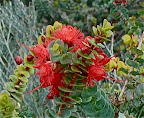
Grevillea/Hakea Pollination. In the unopened bud, the pollen presenter or style (female part of flower) is tucked in next to the anthers. When the flower opens the style extends out and has pollen on the stigma. This will deposit pollen on the pollinator (usually a bird or insect) as in the picture. When this pollen has gone, the style is then ready to pick up other flowers’ pollen from the subsequent pollinators.

From: Wrigley, John W. & Fagg, Murray. (1989). Banksias, Waratahs & Grevilleas. Collins, Sydney. p.30

M. Larke

Saturday, July 24, 2010

Spinifex longifolius - Beach Spinifex

Sources:
Perth Plants (Barrett & Tay) Pg 250
Kiyanti's Blog (nice story)
Photos: M. Taylor

Some of us new guides were walking along Law Walk when we came across a grass that we immediately identified as Spinifex. We just as quickly realized that it didn't look like the specimen located near the old Boab that most of us have discussed with visitors on our walks. In an instant we doubted our knowledge but just as quickly we resolved to research this plant and figure out what it is.

Beach Spinifex grows predictably, all along all the coastal areas of Western Australia and plays a major role in stabilizing the shifting sands of the coast line. It also provides a safe refuge for some of the smaller beach dwellers as well as a low wind break (about 1 meter high) in which to shelter.

The Male and Female flowers of S. longifolius are different and if you go to the photos you can see both. The male flowers make a splayed form atop the grass stem while the female flowers form in a ball which detaches ready to roll down the beach driven by the wind until it lodges into a dune and begins forming a new plant. Right now each of the S. longifolius that I have seen around the park have detached female flowers ready to populate the earth.

Spinifex is from the Latin "spina" meaning "Spine" and "facere" meaning "to make" which refers to the pointed leaves and bristly heads of the plant.

You can find S. longifolius all along Law walk as well as the hard and soft tracks uphill between Roe Gardens and the elevated walkway.

M. Taylor


Friday, July 23, 2010

Hardenbergia comptoniana

From Hardenbergia comptoniana
SOURCES: Perth Plants (Russell Barrett & Eng Pin Tay) 1st Ed. pg 86
Aust Native Plant Society
Photos: P. Wilshaw, M. Taylor

Family: Fabaceae

Common names: Native wisteria

Genus: Hardenbergia - Named by English botanist George Bentham in 1837 after Franziska Countess von Hardenberg, a 19th century patroness of botany who sponsored early botanical research in Australia. The story goes that he was in love with the Countess and named the plant after her beautiful green eyes!

An evergreen, twining woody-stemmed climber, one of the few climbers in Kings Park.
Leaves: Dark green, leathery. Three or rarely 5-folioalate
Flowers: Blue-purple with a yellow-green 'eye', rarely white or pink. Flowers July-October
Pods: Narrow, cylindrical

Found: Dongara to Albany, WA. Common and widespread in bushlands of Kings Park and Bold Park. There are both broad and narrow leaved forms in the parks.

C. Carlton

Thursday, July 22, 2010

Eucalyptus sweedmaniana - Sweedman's Mallee

KEW Gardens
Photos: M. Taylor

Do a web search for Luke Sweedman and you won't be starved for reading material any time soon. Sweedman is Curator for the WA Seed Technology Center at our park. He is an expert in the storage of species for threatened species and some of our guides have come to call him "Sweedman the seedman." His most well known work is "Australian Seeds: a guide to their collection, identification and biology" Sweedman & Barrett.

In 2006, Sweedman was out on a seed collecting expedition with his colleague Professor Stephan Hopper, Director of the Royal Botanic Gardens, Kew when they discovered a new species of Mallee now named Eucalyptus sweedmaniana.

It is a Eucalyptus of the family Myrtaceae and order Myrtales. It is rare and poorly known, which in the Australian system of taxonomy means that there may be less than 5 known populations which are all under threat. In the case of E. sweedmaniana, there is only one known population located in the Mount Arid granitic massif, east of Esperance.

As suggested by it's "Mallee" name it grows in a low multi-stemmed shrub up to about 1 meter high, but as much as 5 meters wide. The pics here were taken from a signed specimen located in the botanical garden, Mallee section, river side of the hard path. Look for the red bloom and of course, the sign.

Luke Sweedman is only one of the many research scientists that are keeping Kings Park in Perth, Western Australia atop a very short list of internationally renowned botanic gardens.

M. Taylor


Wednesday, July 21, 2010

Perga dorsalis (Spitfires)

From Spitfire
Sources: Australian-insects.com
PIRSA Forestry
Photos: M. Taylor

Another chance to talk about Kings Park Fauna!

These little fellows are called Spitfires because when disturbed, they emit a nasty looking yellow mucus from their mouths. They don't really spit; it's more of a drool. You can see some of this goo in the second photo below.

There are other species of crawlies that are called spitfires and some are true caterpillars that may have stinging cells on the ends of hairs that can cause a bit of pain. But not these gooey bugs; they can cause no harm to humans in either their larval or their adult phase and they are not caterpillars at all. They are wasp larvae.

From Spitfire
These guys have recently hatched, and once they have enough energy stored up they will pupate for up to 2 years before they emerge from their cocoons as Steel Blue Saw Flys.

P. dorsalis will always be seen in groups of individuals and they communicate by tapping their tail. You can tell from the first picture that they can do considerable damage to their host tree which is most often a Eucalyptus.

When the Perga dorsalis grows up it will become a wasp but it doesn't sting and it looks more like a large fly (like a horse fly.) I'll direct you to the Australian Insects website for pics of the adult wasp because I don't want to run afoul of any copyright issues and I didn't have time to wait for these fellows to grow up.

M. Taylor

Monday, July 19, 2010

Balga - Xanthorrhoea (Grass Tree)

From Balga
Sources
Monica's Site - most complete
Photos by P. Wilshaw and M. Taylor

Habitat - Throughout Australia, Tasmania

Balga is the aboriginal word for "Black Boy," a term that may be considered offensive to oversensitive white ears, but a term which obviously causes no consternation to our indigenous population. One aboriginal who was told that the term was offensive said "Well then what should I call it?" The term "Black Boy" probably arises from the appearance of the trunk which is exposed when fire burns away the old leaves and turns the trunk black.

Xanthorroea are very slow growing, very long lived plants. Not all species have trunks, but here in the park the X. preissii is the species that grows a trunk. It can take 10 years for the trunk to form from old leaf bases held together by resin. After that, it will be 75-100 years before the trunk is one meter tall. At the end of their life, at around 600 years they may approach 20 ft high.
In many websites you may see that there are 8 species of Xanthorrhoea, but Monica's Site lists a startling 32 species, all native to Australia, but they can be grown in similar climates world-wide with care.

Because they are so slow growing, transplanting grass trees has become an important part of preserving the ones that are removed from mine sites and residential clearings. We have several transplanted balgas in the park that you may have noticed around the new location of the bus stop. They can also be grown from seed as discussed at Monica's Site.

From Balg
Aboriginals used the plant for so many things that one of our guides refers to the grass tree as the "One Stop Shop." We all know that the grass tree exudes a dark red resin when the trunk is heated by fire. That resin was collected, heated and formed into balls for later use when it was re-heated and mixed with charcoal and kangaroo dung to make an epoxy like material to attach sharp stones to sticks making knives, hatchets and the like and to repair broken implements. This same resin was harvested by early European settlers to make varnishes and lacquers. Cans of tinned food were protected with a coating of this lacquer during WWII. The flower stalks are light weight and airy which made them ideal for fire-making by rubbing together. The flowering seed stalks are rich in nectar so they were soaked in water to make a sweet drink. If allowed to sit, this sweet drink would ferment making a slightly alcoholic drink. The seed pods are very tough and were used as a knife to cut meat. Young leaf stalks are a tasty vegetable, and the edible Bardie Grub lives in the crown of the plant. And the dead leaves, if not burned away by fire were be used as thatch and as tender for fire making.
Leaf Cross Sections Balga

In the park, we are limited to only two species, Xanthorrhoea preissii and X. brunonis. X. preissii is the "common grasstree." It grows a tall trunk and has a diamond shaped cross section in the leaf. The grasstree at the Tuart Lawn entrance to the Banksia Garden is a X. preissii and is about 200 years old. X. brunonis grows close to the ground with no trunk, has a narrow seed stalk better for using as fire sticks and a triangular cross section to the leaf.

The seed stalk, regardless of the species can grow at a rate of 2-3 cm per day and can reach lengths of 3 meters. The stalk is packed with nectar and attracts a wide variety of insect, bird and mammal polinators. P. Wilshaw got a picture of bees and a wattyl bird working the same two stalks in the park. He also got a picture of a bee flying into a seed stalk upside down. Maybe that nectar can ferment on its own? Click on any of the pictures to the right to be taken directly to the Balga section of the KPGuides photo album.

M. Taylor

Wednesday, July 14, 2010

Pandanus aquaticus - River Pandan

From Pandanus aquaticus
Location in Park - Botanic Garden, Kimberly section, interspersed with young Boabs
Habitat- Kimberly, coastal areas, anywhere that Mangroves would grow
Sources - Florabase, Gondwananet

We have several Pandans in the park, all located in the Kimberly Section of the Botanical Garden very near one another.  You will notice the first one just as you enter the Kimberly section coming from the VIC toward the Big Boab.  It is trimmed higher than the rest and you can clearly see the trunk and the prop roots emerging from the ground.  These roots help take up oxygen when the trunk is partially submerged in its natural habitat, and they also support the weight of the tree in the soft shifty soil where it normally grows.

Years ago, according to documents found by B. Mowe, we had one P. tectorius (Screw Pine) located in that same area, but it is no longer to be found.  The fact that it used to be there has caused some confusion amongst guides, but there is a well hidden sign that dates back to at least 2007 labeling the remaining plants as P. aquaticus aka River Pandan or Water Pandan.

From Pandanus aquaticus
Two of our Pandans are fruiting and they are located across the concrete path going down hill before you get to the Spinifex, Verticordia and the Big Boab..  The fruits are very large and currently green, but they turn bright red as they ripen.  While the fruit of P. tectorius and some other species are edible, the, P. aquaticus fruit is not.  In the edible species, aboriginals used the fruit for food and medicine, the leaves for clothing and fishing.  Bats, crabs and rats also eat the fruit.

One other plant near the main walkway in the Kimberly section of the garden has just finished flowering and you can still see the remnants of the creme colored flower fading with age.

From Pandanus aquaticus
Pandans are primitive, having  Male and Female sexes in separate plants.

This article may be incomplete.  Please contribute to this article by e-mailing the author if you have interesting information regarding Pandanus aquaticus.

M. Taylor

Nesting Ospreys

From Osprey
While the Flora in our park is spectacular and more than sufficient to maintain our interest for decades, it always pleases me to find a bit of Fauna to discuss.  Having heard a rumor last week of nesting birds near the park which were either White Bellied Eagles or Ospreys, I set out to discover where the nest might be.   I found it along the Swan River, clearly visible from Law Walk in the tallest of the 6 Norfolk Island Pines which are in the first cluster of Pines down river from the old brewery.  The fastest way to get there is to park at Roe Gardens and make your way down to the Law Walk, which is the lowest of the concrete paths along the escarpment.  When you reach the Law Walk, turn right and head down river while looking left toward the bay.  When you come upon the cluster of Pines, look at the tallest one and you will notice a dense matting of leaves, twigs, string, and maybe some plastic bags.  If you are lucky, you will see both of the adults coming and going which is more than entertaining.

From Osprey
These birds are Ospreys (Fish Eagles) but they might be confused with White Bellied Eagles from afar.  Both have white heads, but the Ospreys eyes are more forward pointing than the eagles, and the Osprey has a distinct black band visible behind the eye whereas the eagle is white in that area.

Clicking "Osprey" text below the images in this post will take you to more images available at my Picassa Website.

I hope you enjoy this bit of birding in our park and I further hope the guests that you guide will appreciate this bit of fauna amongst our flora.

M. Taylor

Tuesday, July 13, 2010

"Turner of Hearts" Verticordia grandis


Sometimes I change my plans. Rarely I change my mind. But to change a heart is something unique and rare. Verticordia means “Changer of Hearts” in Latin and this plant is named Verticordia after the goddess Venus of whom it was said was so beautiful she could change a persons heart with a glance.
This particular flower is from Verticordia grandis which is the only Verticordia species that is blooming in the garden right now. There are several other species that are commonly referred to as “featherflower” and I’ll try to post some pics of them as they start to show off in the spring. The common name for V. grandis is “Scarlet Featherflower.”
Even without flowers, the scarlet featherflower would be a show piece. It is a shrub, normally about 4-5 ft high but can grow to 12 ft. It is endemic to a small area just north of Perth and up to Geraldton. In the wild it can be wiry, short and unimpressive, but here in the botanical garden where it is pampered it is always a point of interest.
The main stems are blood red when they are young and they provide support for hundreds of strangely pale green leaves attached directly without a separate leaf stem. There are two leaves at each connection and each connection is offset from its nearest neighbor by 90 degrees which gives the leaves the appearance of surrounding the stem in a continuous spiral. Each leaf is also edged by a blood red outline encircling the leaf.
Touching a leaf here is almost always surprising because what looks soft is often hard, and vice versa. These leaves are soft to the touch, not quite like velvet, but not like a normal shrub leaf either.

Despite the beauty of the stems and leaves, the flowers of the Verticordia grandis are the real attraction. It is called a featherflower because the calyx lobes are fringed. The Calyx of a flower is the group of sepals that support the petals from underneath. Normally in the US and most of the rest of the wold, the sepals are green, but here in Australia, all bets are off and in the scarlet featherflower they are the same red color as the petals. The five petals are inside the calyx and they are fused together to form a tube. Insects travel down this tube in search of nectar and they collect pollen along the way to be used to fertilize next flower they visit. On some flowers you can see a long thin red spike curving out from the calyx and that spike is the style that contains the stigma on its end.

The featherflowers, like all plants in WA are susceptible to fire. Many plants here require fire to multiply with their seeds laying dormant for years until the fires come. But for the featherflower seeds germinate normally without fire. When fire does come, the Verticordia regenerates by sprouting new stems from lignotubers just underground.


M. Taylor

Granite Bottlebrush (Mellaleuca elliptica)

From Granite Bottlebrush
The Melaleuca elliptica is sometimes called Granite Honey Myrtle, but here in King's Park we call it Granite Bottlebrush. "Melaleuca" is a compound of latin terms “melan” meaning black and “leuca” which means white.

Several species here in Australia are named in a sort of strange way which reflects the utter confusion of the early european explorers.  Fire is a predominant and necessary part of the landscape here but the europeans didn’t know that. What likely happened was that the first of the Melaleuca species to be described had been recently affected by fire which blackened the trunk on the lower regions while leaving the upper branches a white color in new growth areas.  You can see an example of the white branches on the far right hand edge of this pic. White branches are more common here than you might think, but I don’t want to talk about them right now.  There is a better example of that phenomenon to discuss later.   Suffice it to say that the "white & black" name really isn't very descriptive of this plant.

The "flower" you see in this pic is actually more than a hundred flowers grouped together called a fluorescence.  Individual flowers are made up of five very reduced petals which encircle a tight group of stamens.  Grouping a hundred or so of these together gives the plant the characteristic bottlebrush look.  Unlike the Verticordia that we recently discussed, the sepals of the Melaleuca do not play a part in the fluorescence display. The reduction of the petals is a strategy to help conserve water that is shared by other plants here in Australia.  The normal function of the petals to attract pollinators has been taken over in large part by the colored stamens.

The plant from which I took this picture is about normal sized being a little over 6 ft high and about half as wide.  It is a tall shrub and can be pruned into a hedge.  It tolerates drought well after it is established.  Like many of our plants it flowers a good part of the year, but its best show is during spring (Sept-Nov.)

From Granite Bottlebrush
This shrub is a type of “mallee” which means “multiple trunks” and there are so many Malees in a small region along the Southern coast of Western Australia that the region itself is referred to as the Mallee Region.  Think of a crepe myrtle and you are thinking of a mallee.  I’ll post a pic of the trunk of a mallee at some point so stay tuned.


The bottlebrush is pollinated by both insects and birds who love the nectar.  The day I was taking the pic there was a bee on the flower the entire time.  If you look closely you can pick him out.  He isn’t a native bee, rather he is a common european honeybee.  I am hopeful that one day I will get a pic of one of the 16 species of native stingless bees, but so far, no luck.

Notice too the small elliptical leaves and how tightly they grow to the stems.  The leaves are where the “elliptica” part of the name comes from and the leaves are a dusty green color.  The color is an adaptation to the intense sunlight here.   Another thing I will discuss in later posts.


You can also see last season’s flower in this pic which is the spiky growth up and to the left of the flower.  If the resolution on your screen is sufficient, you can zoom in on that part of the pic and see some seeds still hanging on.


M. Taylor


Kangaroo Paw (Anigozanthos)

From Kangaroo Paw

The flower I should have started with is the Kangaroo Paw.  I hope you enjoyed the Scarlet Featherflower sufficiently to forgive putting it ahead of the Kangaroo Paw, which is Western Australia’s state flower (they call it the state floral emblem here.)  Specifically the Anigozanthos manglesii aka the Red and Green Kangaroo Paw is the state flower.   The pic here is a mosaic at the entrance to the Botanic Garden that shows a representation of the Red and Green Kangaroo Paw.

For a flower to have red stems is unusual.  For a flower to have green petals is very unusual.  For a flower to have red stems and green flowers... well, you do the math.
From Kangaroo Paw

I mentioned before that touching leaves here is often a surprise, but touching the Kangaroo paw parts yields about what you would expect if you were here to see the plant.   The stem is fuzzy with millions of tiny hairs up and down it’s length.   My Pics probably don’t capture it, but just imagine a very thin version of a cat tail head and that’s about what the red stem of the red and green kangaroo paw feels like.

From Kangaroo Paw

The flower is pollinated by birds (of all things.)  There are no bird pollinated plants in Europe, and the hummingbird is the only pollinating bird in the US.  But here in Australia, about 17% of the plants are pollinated by birds ranging  from the tiny honey eaters to the fairly large wattle bird.  

The bird lands on the kangaroo paw stem and seeks nectar inside the tubular flower.   When it does, the five stamens that make up the “paw” of the flower smack the bird on top of the head leaving pollen behind.   When the bird visits the next flower.. well you get the picture.  Interestingly, each species of Kangaroo Paw hits the bird in a slightly different place.   This does not prevent cross pollination, as there are other characteristics that do that, but it does help conserve pollen by not wasting it where it cannot be utilized.  These plants are pretty smart.


From Kangaroo Paw

There are at least 8 species of Anigozanthos that I know of.   Here is a pic of the Yellow Kangaroo Paw (Anigozanthus pulcherrimus.)  Remember you can click on any pic to get a bigger version and be directed to my Picassa site where there is no telling what you might find.  But there is also my favorite Kangaroo Paw, the Black Kangaroo Paw pictured below.  Once again with green flowers, but a more pale green... and this time with BLACK STEMS.  Whoever heard of a black stemmed flower?  

From Kangaroo Paw

The Black Kangaroo Paw is not in the same genus as the rest, which means it is really not closely related to the other types.   Charles Darwin never visited Western Australia, but if he had, and if he had modern DNA testing technology, at least some of the points of his theories would have been different.   Darwin, in order to support his ideas about all life stemming from a single ancestor, said that it is extremely unlikely that two separate species would ever develop similar methods of adapting to a habitat.  Well, that doesn’t turn out to be true as is exemplified by the Black Kangaroo Paw which is in the genus Macropidia (Macropidia fuliginosa) instead of Anigozanthos, like the rest of the Kangaroo Paws.   Can’t really hold him too responsible for the issue though because it probably does take DNA testing to figure it out.

So these are the Kangaroo Paws.  You might see some similar species in the US called Cats Paws.  Generally smaller than these, but similar looking.


M. Taylor

Sunday, June 27, 2010

Granite Bottlebrush (Mellaleuca elliptica)

From Granite Bottlebrush
The Melaleuca elliptica is sometimes called Granite Honey Myrtle, but here in King's Park we call it Granite Bottlebrush. "Melaleuca" is a compound of latin terms “melan” meaning black and “leuca” which means white.

Several species here in Australia are named in a sort of strange way which reflects the utter confusion of the early european explorers. Fire is a predominant and necessary part of the landscape here but the europeans didn’t know that. What likely happened was that the first of the Melaleuca species to be described had been recently affected by fire which blackened the trunk on the lower regions while leaving the upper branches a white color in new growth areas. You can see an example of the white branches on the far right hand edge of this pic. White branches are more common here than you might think, but I don’t want to talk about them right now. There is a better example of that phenomenon to discuss later. Suffice it to say that the "white & black" name really isn't very descriptive of this plant.

The "flower" you see in this pic is actually more than a hundred flowers grouped together called a fluorescence. Individual flowers are made up of five very reduced petals which encircle a tight group of stamens. Grouping a hundred or so of these together gives the plant the characteristic bottlebrush look. Unlike the Verticordia that we recently discussed, the sepals of the Melaleuca do not play a part in the fluorescence display. The reduction of the petals is a strategy to help conserve water that is shared by other plants here in Australia. The normal function of the petals to attract pollinators has been taken over in large part by the colored stamens.

The plant from which I took this picture is about normal sized being a little over 6 ft high and about half as wide. It is a tall shrub and can be pruned into a hedge. It tolerates drought well after it is established. Like many of our plants it flowers a good part of the year, but its best show is during spring (Sept-Nov.)
From Granite Bottlebrush
This shrub is a type of “mallee” which means “multiple trunks” and there are so many Malees in a small region along the Southern coast of Western Australia that the region itself is referred to as the Mallee Region. Think of a crepe myrtle and you are thinking of a mallee. I’ll post a pic of the trunk of a mallee at some point so stay tuned.

The bottlebrush is pollinated by both insects and birds who love the nectar. The day I was taking the pic there was a bee on the flower the entire time. If you look closely you can pick him out. He isn’t a native bee, rather he is a common european honeybee. I am hopeful that one day I will get a pic of one of the 16 species of native stingless bees, but so far, no luck.

Notice too the small elliptical leaves and how tightly they grow to the stems. The leaves are where the “elliptica” part of the name comes from and the leaves are a dusty green color. The color is an adaptation to the intense sunlight here. Another thing I will discuss in later posts.

You can also see last season’s flower in this pic which is the spiky growth up and to the left of the flower. If the resolution on your screen is sufficient, you can zoom in on that part of the pic and see some seeds still hanging on.

oVo

Saturday, June 26, 2010

Kangaroo Paw (Anigozanthos)

From Kangaroo Paw
The flower I should have started with is the Kangaroo Paw. I hope you enjoyed the Scarlet Featherflower sufficiently to forgive putting it ahead of the Kangaroo Paw, which is Western Australia’s state flower (they call it the state floral emblem here.) Specifically the Anigozanthos manglesii aka the Red and Green Kangaroo Paw is the state flower. The pic here is a mosaic at the entrance to the Botanic Garden that shows a representation of the Red and Green Kangaroo Paw.

For a flower to have red stems is unusual. For a flower to have green petals is very unusual. For a flower to have red stems and green flowers... well, you do the math.
From Kangaroo Paw
I mentioned before that touching leaves here is often a surprise, but touching the Kangaroo paw parts yields about what you would expect if you were here to see the plant. The stem is fuzzy with millions of tiny hairs up and down it’s length. My Pics probably don’t capture it, but just imagine a very thin version of a cat tail head and that’s about what the red stem of the red and green kangaroo paw feels like.

From Kangaroo Paw
The flower is pollinated by birds (of all things.) There are no bird pollinated plants in Europe, and the hummingbird is the only pollinating bird in the US. But here in Australia, about 17% of the plants are pollinated by birds ranging from the tiny honey eaters to the fairly large wattle bird.

The bird lands on the kangaroo paw stem and seeks nectar inside the tubular flower. When it does, the five stamens that make up the “paw” of the flower smack the bird on top of the head leaving pollen behind. When the bird visits the next flower.. well you get the picture. Interestingly, each species of Kangaroo Paw hits the bird in a slightly different place. This does not prevent cross pollination, as there are other characteristics that do that, but it does help conserve pollen by not wasting it where it cannot be utilized. These plants are pretty smart.


From Kangaroo Paw
There are at least 8 species of Anigozanthos that I know of. Here is a pic of the Yellow Kangaroo Paw (Anigozanthus pulcherrimus.) Remember you can click on any pic to get a bigger version and be directed to my Picassa site where there is no telling what you might find. But there is also my favorite Kangaroo Paw, the Black Kangaroo Paw pictured below. Once again with green flowers, but a more pale green... and this time with BLACK STEMS. Whoever heard of a black stemmed flower?

From Kangaroo Paw
The Black Kangaroo Paw is not in the same genus as the rest, which means it is really not closely related to the other types. Charles Darwin never visited Western Australia, but if he had, and if he had modern DNA testing technology, at least some of the points of his theories would have been different. Darwin, in order to support his ideas about all life stemming from a single ancestor, said that it is extremely unlikely that two separate species would ever develop similar methods of adapting to a habitat. Well, that doesn’t turn out to be true as is exemplified by the Black Kangaroo Paw which is in the genus Macropidia (Macropidia fuliginosa) instead of Anigozanthos, like the rest of the Kangaroo Paws. Can’t really hold him too responsible for the issue though because it probably does take DNA testing to figure it out.

So these are the Kangaroo Paws. You might see some similar species in the US called Cats Paws. Generally smaller than these, but similar looking.

Thursday, June 24, 2010

Turner of Hearts

From Verticordia grandis
Sometimes I change my plans. Rarely I change my mind. But to change a heart is something unique and rare. Verticordia means “Changer of Hearts” in Latin and this plant is named Verticordia after the goddess Venus of whom it was said was so beautiful she could change a persons heart with a glance.

This particular flower is from Verticordia grandis which is the only Verticordia species that is blooming in the garden right now. There are several other species that are commonly referred to as “featherflower” and I’ll try to post some pics of them as they start to show off in the spring. The common name for V. grandis is “Scarlet Featherflower.”
Even without flowers, the scarlet featherflower would be a show piece. It is a shrub, normally about 4-5 ft high but can grow to 12 ft. It is endemic to a small area just north of Perth and up to Geraldton. In the wild it can be wiry, short and unimpressive, but here in the botanical garden where it is pampered it is always a point of interest.

From Verticordia grandis
The main stems are blood red when they are young and they provide support for hundreds of strangely pale green leaves attached directly without a separate leaf stem. There are two leaves at each connection and each connection is offset from its nearest neighbor by 90 degrees which gives the leaves the appearance of surrounding the stem in a continuous spiral. Each leaf is also edged by a blood red outline encircling the leaf.

Touching a leaf here is almost always surprising because what looks soft is often hard, and vice versa. These leaves are soft to the touch, not quite like velvet, but not like a normal shrub leaf either.


Despite the beauty of the stems and leaves, the flowers of the Verticordia grandis are the real attraction. It is called a featherflower because the calyx lobes are fringed. The Calyx of a flower is the group of sepals that support the petals from underneath. Normally in the US and most of the rest of the wold, the sepals are green, but here in Australia, all bets are off and in the scarlet featherflower they are the same red color as the petals. The five petals are inside the calyx and they are fused together to form a tube. Insects travel down this tube in search of nectar and they collect pollen along the way to be used to fertilize next flower they visit. On some flowers you can see a long thin red spike curving out from the calyx and that spike is the style that contains the stigma on its end.
From Verticordia grandis

The featherflowers, like all plants in WA are susceptible to fire. Many plants here require fire to multiply with their seeds laying dormant for years until the fires come. But for the featherflower seeds germinate normally without fire. When fire does come, the Verticordia regenerates by sprouting new stems from lignotubers just underground.

Wednesday, June 23, 2010

Kings Park (Perth, Western Australia)


I have recently been certified to lead guided walks through Kings Park here in Perth and one of my friends said she might be interested to see some pics of the strange plants here and maybe read a little of the presentation we make in the park. Well, here goes.

Intro
Kings Park is the largest inner city park in the world. It is just under 1000 acres with 2/3 of it preserved as "native bushland." Seventeen acres are utilized as a botanical garden and the rest is playgrounds, cafes and expansive lawns for the public to use.

Perth itself is a city of about 2 million people, but the park land was set aside back in 1872 when the population of Perth was about 9,000 and there were less than 25,000 people in all of Western Australia. WA is five times the size of Texas and it is more than 1300 miles from Perth to the nearest city of more than 1 million people. Perth is the most isolated city in the world in terms of geographic distance to anything of consequence.

The park is on a high hill overlooking the Swan River Basin and Matilda Bay. Across the basin is a clear view of the Perth Hills aka The Darling Range, named after General Ralph Darling who put together the expedition of Captain James Stirling aboard the HMS Success that established the Swan River Colony (Perth.) The hill on which Kings Park sits is named Mt. Eliza after Darling's wife. No one ever accused Perth's early settlers of being anything short of politically astute. The park is actually on the most attractive land in all the Swan River Valley... just the sort of place I would have put my house if I had been Stirling. (No one ever accused me of being in the least, politically astute.)

The land in the Swan River Valley is very poor. Australia is a continent as opposed to an island. It used to be part of the ancient super continent Gondwana until it drifted South and West to its current location. There have been no "earth creating events" here for millions of years. No earthquakes, no volcanoes, nothing. The primary geologic player has been erosion with the rain, wind and sea working year after year to leach out and erase any remnant of nutrient in our "soil" and leaving only a layer of sand atop a limestone base. Not really ideal conditions for growing plants, much less food crops. This poor soil played a huge role in checking any population growth in the area until gold was discovered in 1892. That year Perth's population doubled and it was over 130,000 two years after that.

It rains only about 3 or 4 months and all in the winter months of the year (June-August) and the rest of the time the sun streams down unimpeded by clouds. We have a mild climate, but the sun is strong, even if not hot. The poor soil and oppressive sun of our area may seem like a detriment to botanical life, but instead it has provided a perfect laboratory for life to adapt. Being so remote to the rest of the world, the plants here, like the animals, have taken a path not shared by the rest of the world and as a consequence there are more than 4000 known species of plants in the southwest corner of WA, more than in any other similar sized area in the world, and over 80% of them occur nowhere else in the world.

A year ago when I arrived here, I took a series of bushwalks into the wild. On those walks it seemed like I couldn't go 10 yards without seeing some plant that looked different than anything I had seen before and I decided to try to learn a thing or two. That led me to the botanical garden and in turn, to the guides program.

Well, enough background. Just keep in mind the notes about the soil and sun. Those features will likely be a recurring theme in my discussions as I post pictures of the plants here.

Like any tour, this will work best with comments from the folks that read this. If I have your comments, I can gauge levels of interest and adjust what I post to the things that seem interesting to you. Otherwise, you can read what I write.. or not. I hope you enjoy it though, because I do.

I'll close out this post now and maybe tomorrow I'll post a bit about a flower here that is purported to be able to "turn hearts."

Welcome to Kings Park.

"Black Swan in Perth Water"

Sunday, August 17, 2008

Beijing, China - 2008 Olympics

I’m really struggling to put together a post on our trip to the Olympics in Beijing. It would be easy and a little gratifying to lay into China for the pollution and lack of drinking water availability along with its oppressive government that electronically bugs taxi cabs and hotel rooms and censors the internet and broadcast media. But I guess that’s not really my job in this BLOG so I suppose I will stick to the Olympics and the site seeing we did.

This trip was out of character for me since I am not a spectator sport sort of person. I don’t watch pro sports in the US much, and in all my (extended) time at LSU I only went to one football game. At Tulane, I didn’t go to any sports events. But the Olympics were really a treat. The athletes were amazing to watch, even in the early rounds when world class performances were just imperfect enough to show how amazingly difficult the feats really were. Watching things like women’s gymnastics on TV sometimes gives the impression that all of these teenage girls can do everything every time, but seeing the early rounds in person reveals that mistakes do happen and sometimes they are dramatic. Watching the Olympic swimmers doing their warm up and then effortlessly lifting themselves up and onto the pool deck in a single motion two feet above the water points out that not only can normal people not swim the same speeds as these guys, we can’t even get in and out of the pool the same way.

Watching the early rounds of volleyball left me with the idea that in earlier years I could have been down there playing, but as the elimination rounds progressed and the folks that probably should never have been there were defeated, the play improved and I quickly realized that I would have been one of the ones eliminated early.

The opening ceremonies were spectacular in the truest sense of the word. They were fantastic with perfect synchronization amongst hundreds of people at a time, and display after display of similar perfection. We were in the Bird’s Nest for six hours on opening night and didn’t see a single thing that could be called a mistake. Amazing. The fireworks set a new Guinness record with over 120,000 individual rounds fired over an 8 kilometer long path in the city. From inside the stadium we could see almost none of the fireworks, but we could see what you saw on TV from the jumbotrons inside and fireworks were still going off by the time we got out of the stadium at the end of the event. Just fabulous.

The Olympic venues were also spectacular. The Bird’s nest is something to see, but my favorite was the Water Cube. A building made principally of a visqueen like plastic in which the air that fills each “plastic pillow” is a structural element of the design. Amazing.

Because of the pollution, China will never make my list of favorite places to visit. How bad was the pollution? On our first day we could not quite make out the top of a cell phone tower in the city. On our tour of the Great Wall we could see only one or two battlements in any direction and we stood wishing that the day was clear so we could really take in this amazing structure.

But walking on the Great Wall was a singular experience. Our pictures aren’t great, but the experience was memorable. Strolling though the Forbidden City with its stark, vast squares designed to intimidate even the military was startling. The Forbidden City is mostly just a big empty space devoid of monuments or structure with any purpose but to intimidate and communicate absolute power. It is stark and lonely feeling in these days when it is merely a museum to days long gone. The same goes for Tienmen Square which is just huge and only slightly softened by the small gardens and special monuments that were erected for the Olympics. You never forget that the government in this country is all powerful and that “by the people, for the people” never entered anyone’s mind when it was founded or since.

China is without the exotic beauty that we found in other places in Asia we have visited. The monuments were to men gone but not forgotten and the architecture is purposed to intimidate. With almost no religion anywhere in the country, there are no temples, not even ones to false gods and that seems to leave only political reasons to build.

The people we came into contact with were typically Asian ie. smiling, pleasant and very accommodating to our needs at every point possible.

We learned after we got home that “bald and smelly” cab drivers had been taken off the road by the government.

We learned while we were there that violation of any of the “special laws” enacted for the Olympics are punishable by prison time and heavy fines. This includes unauthorized usage of the “Olympic Lanes” on the expressways and it was obvious that this law was strictly enforced because our bus had permission to use this lane and despite 3 or 4 other lanes being backed up for miles, we sailed down our lane completely alone on most occasions. Trips that we were told would take 1 – 1 ½ hours took us less than 15 minutes in some cases.

We learned after we left the country that many people were displace from their homes in order to clear the land needed for the Olympic venues. In the places where these people were relocated, signs were erected by the government saying “I participate, I contribute, I am happy.”

Well, I guess I couldn’t stick to the site seeing after all. God Bless America.

oVo

Saturday, July 19, 2008

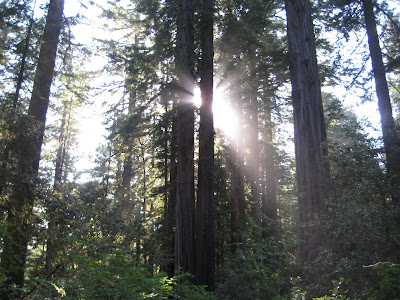
Redwood National Forest


Brenda grabbed a much deserved day off Friday and we hustled North to the edge of California where we found the Redwoods National Forest. It was a long trip for an overnighter, but we've gotten pretty good at finding the good stuff when the opportunity arises. We made the most of this trip by taking a nice back-roads drive up through the perpetually congested Napa wine region, and then up through Geyserville before rejoining Hwy 101 at the Southernmost end of the Mendocino National Forest. The roads North of Calistoga on this route are excellent motorcycle roads, but there was alot of construction near where we joined up with 101. In CA they like to just shut down a lane and let cars through from one direction for a half hour and then the other direction. We hit it pretty bad this time and had a few long waits for our turn.

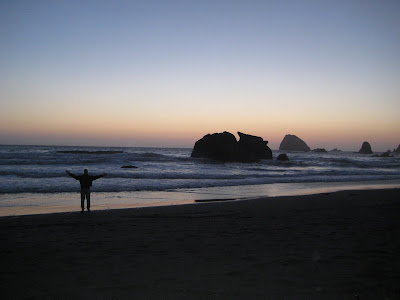
Having gotten off to a late start in the morning and being blocked by construction a few times, we arrived at our motel and turn around spot in Klamath, CA at about 7 PM and had some dinner. There was still light after we ate so we ambled over to a little trail near the hotel that said "Hidden Beach" but didn't give any indication of how far it might be. The trail was nice, but it was jungle. You know how dark it can be in the woods during the day and for us the sun was barely up when we entered the trail. Brenda led us briskly down the trail for about 15 minutes and we finally started hearing surf. A few minutes later and we were rewarded with the coolest beach I have ever seen. The beach was a half moon shape with huge rocks jutting out of the surf in random places. The beach sand was charcoal grey, almost black and as fine as flour, but more dense. The surf was "angry" and it just could not have been a more interesting place. I hated to pull us away after a 15 minute visit, but I knew the forest would be even darker by now. Sure enough....

We made it back to the world just fine after taking the right turn that we knew we had to take whether we could actually see the trail or not and somehow remembering the following right hand turn where the trail wanted to go straight. No big deal and definitely one of the things that made this trip and adventure.

In the morning we got up and rode the gondola to the top of the hill across the street from our hotel. It was foggy so we couldn't see much at the top, but the ride up was still interesting to see the sequoias, firs and spruce from this squirrels eye view.

We jumped back in the car and made our way to Fern Canyon where we walked down to the beach for more angry surf, then continued our route south homeward, but not before ignoring our GPS plea to keep us off an unpaved road that we figured would be a mile or two long. Forty miles later our jostled and juggled sports car looked like it had survived a Texas dust storm. Just another adventure. I must admit that when the GPS finally gave up and started plotting our position on a completely blank screen with no roads shown, and we had to decide if the spray paint arrow on the tree trunk saying "Hoopa ------>" could be trusted, I had had enough adventure for a bit.

When we emerged from the wilderness, we found ourselves blocked by a sports car club that had commandeered the road for the day to run speed trials up a 2.5 mile section of road. We had to wait for the heat to end before we could go back down the mountain with the race cars. They offered to let us run with the next heat since we were in the right kind of car, but I found out that the fastest time for the 2.5 mile course was 2 minutes and 13 seconds. This was on a mountain road, uphill with at least 6 hair pin switchback turns. In other words, they were averaging almost 70 mph from a standing start. I wasn't sure I could go that slow (HA!) Only one guy had lost his car off the road so far that day.

After more great mountain roads Southeast through Trinity National Forest we finally joined back up with the Interstate crowd to make tracks home. Great trip.

Click on any of the pics to see the rest of them at the web album

oVo
Thursday, June 26, 2008

Police Riding School

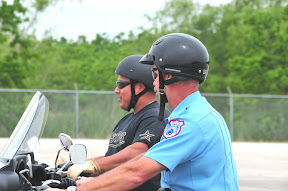
Back in May I lucked into the opportunity to participate in a 40 hour riding school put on by the Texas City Police Department. I have a friend that sells Harley Davidson Motorcycles and one of his customers invited him to come to a day of classes and my friend invited me. I was able to stay all week and complete the course. I am the only civilian that Texas City has ever certified as completing this course. 'Course I can't give tickets, but I sure learned a lot.

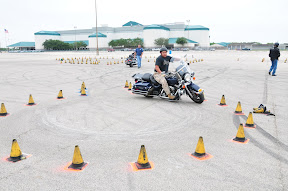
This is one post where I really suggest that you click on one of the pictures which will take you to the web album where the rest of the pics are stored. These pics are truly worth a thousand words and this class was worth a thousand bucks to me. Don't tell Texas City though, they may send me a bill.

I've been riding since I left home at 18 years of age. I have ridden all sorts of bikes. Dirt bikes, small street bikes, exotic Moto Guzzis, metric and HD. I've always paid attention on the street and I have takes some classes that teach riding skills. I thought I was a pretty good rider but this course really showed me that I didn't know much about handling my bike at slow speed in tight quarters. I think I learned a lot though, and developed confidence that I can put my bike where I want it to be.

The course consisted of six distinct cone layouts where the object was to avoid the cones. Speed did not matter, go as slow as you want or as fast as you can, just avoid the cones. We were all on 800+ lb Harley's except for one guy on a Honda Valkrye and two guys on BMWs. The Harleys all handled the course better than the other bikes because of the HD lower center of gravity and shorter wheel base. Each of the bikes can complete the course though, but with greater difficulty on the Honda due to the wheel base and the BMW due to the clutch set-up.

The first course was a slow weave in which cones were set about 18 feet apart and we just weaved back and forth between them. We were justifiably proud to complete that course with relative ease, but it turns out that the slow weave was just a tune up for the Offset Weave.

In the Offset, the cones are not in a straight line, but are offset by about 18 feet so that you have to make a hard turn at the first cone to line up on the next cone 18 feet away and requiring a 90 degree turn. Assuming you clear the second cone there is another one 18 feet away that may be a little tougher to clear depending on how you ride. Each mistake in position, speed or direction on these courses adds up on you because the layout of the course doesn't allow much room for corrections. If you are off by a foot on the first turn, you may be off by two feet on the second and so forth. A skilled rider can make up for small mistakes, but not for big ones, and we unskilled riders couldn't even make up for small mistakes at first.

It took us two full days to get everyone through the offset cones and onto the lane change course. The object on the lane change was to simulate the need to change lanes on a highway, but to do it in about 15 feet without knocking over any cones. Keep in mind that our bikes are about 6 feet long and we all had saddle bags that stick out and the bags were low enough to strike the cones.

After the offset and lane change we moved on to the 18 foot intersection. This course is best thought of as a big "Plus sign" with each end of the sign and each segment of the sign being 18 feet wide/long. We had to enter the intersection at one end and make a hard turn at each corner driving the bikes as far into each leg of the intersection as we could. Each turn in this course required a "wheel lock" turn in which the handlebars were forced as far as possible into the turn. The only way to straighten the bike at that point was with speed. Increase speed and you straighten up. Decrease speed and you fall down. A very interesting balancing act. It took most of us two days to master this course and some of us took even longer. It was only a five day course. Time got tight.

After the Intersection we only had a high speed "Maximum Effort Stop" and the Keyhole to go. The high speed stop was interesting because we performed it first using just back brake, and then with just the front brake. Finally we stopped using both brakes together. I am glad that I have two brakes.

The Keyhole was an 18 ft diameter circle of cones with a 4ft wide X 4ft long entrance/exit. We had to enter the keyhole, perform a full circle and exit out the same hole without touching a cone. OH... and did I mention that we had to do all these courses clockwise AND counterclockwise? Well, we did.

This course was a really great time for me. It was hard on my bike, but I gained alot of skill and confidence in putting my bike exactly where it needs to be every time and it showed me that no matter how good a rider I thought I was, there are always skills to be learned and more fun to be had in our sport.


oVo