|
| From Granite Bottlebrush |
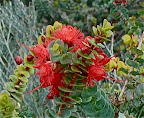
The Melaleuca elliptica is sometimes called Granite Honey Myrtle, but here in King's Park we call it Granite Bottlebrush. "Melaleuca" is a compound of latin terms “melan” meaning black and “leuca” which means white.
Several species here in Australia are named in a sort of strange way which reflects the utter confusion of the early european explorers. Fire is a predominant and necessary part of the landscape here but the europeans didn’t know that. What likely happened was that the first of the Melaleuca species to be described had been recently affected by fire which blackened the trunk on the lower regions while leaving the upper branches a white color in new growth areas. You can see an example of the white branches on the far right hand edge of this pic. White branches are more common here than you might think, but I don’t want to talk about them right now. There is a better example of that phenomenon to discuss later. Suffice it to say that the "white & black" name really isn't very descriptive of this plant.
The "flower" you see in this pic is actually more than a hundred flowers grouped together called a fluorescence. Individual flowers are made up of five very reduced petals which encircle a tight group of stamens. Grouping a hundred or so of these together gives the plant the characteristic bottlebrush look. Unlike the Verticordia that we recently discussed, the sepals of the Melaleuca do not play a part in the fluorescence display. The reduction of the petals is a strategy to help conserve water that is shared by other plants here in Australia. The normal function of the petals to attract pollinators has been taken over in large part by the colored stamens.
The plant from which I took this picture is about normal sized being a little over 6 ft high and about half as wide. It is a tall shrub and can be pruned into a hedge. It tolerates drought well after it is established. Like many of our plants it flowers a good part of the year, but its best show is during spring (Sept-Nov.)
 |
| From Granite Bottlebrush |
This shrub is a type of “mallee” which means “multiple trunks” and there are so many Malees in a small region along the Southern coast of Western Australia that the region itself is referred to as the Mallee Region. Think of a crepe myrtle and you are thinking of a mallee. I’ll post a pic of the trunk of a mallee at some point so stay tuned.
The bottlebrush is pollinated by both insects and birds who love the nectar. The day I was taking the pic there was a bee on the flower the entire time. If you look closely you can pick him out. He isn’t a native bee, rather he is a common european honeybee. I am hopeful that one day I will get a pic of one of the 16 species of native stingless bees, but so far, no luck.
Notice too the small elliptical leaves and how tightly they grow to the stems. The leaves are where the “elliptica” part of the name comes from and the leaves are a dusty green color. The color is an adaptation to the intense sunlight here. Another thing I will discuss in later posts.
You can also see last season’s flower in this pic which is the spiky growth up and to the left of the flower. If the resolution on your screen is sufficient, you can zoom in on that part of the pic and see some seeds still hanging on.
oVo